What stays the same across gummies and powder
The first thing most people notice isn’t the creatine at all—it’s the routine. A gummy feels like a snack you remember, while powder feels like “one more scoop” you have to mix. But underneath that, the active ingredient you’re paying for is the same idea: a daily amount of creatine meant to build up over time rather than “hit” right after one workout.
That’s why the day-to-day outcome tends to hinge on consistency more than the format. If you take enough creatine most days for weeks, your muscles can gradually hold more of it; if you miss days or keep under-dosing, it can feel like nothing is happening even though the product itself isn’t “bad.” Gummies and powder both depend on that slow, cumulative pattern—which is also where real life gets messy.
Effectiveness depends more on dose than form
You might notice it when you look back at a week and realize the “easy” option didn’t automatically mean you got the full amount. A gummy day can feel like you took creatine, but if the label’s serving is 4–6 gummies and you only grabbed two on the way out the door, the dose quietly shrinks.
That’s the main reason effectiveness tends to track grams per day more than whether it’s chewy or mixable. Your muscles don’t really “care” about the format; they respond to steady intake over time. If you’re consistently hitting a target amount (often around 3–5 grams daily for many people), the buildup tends to be more predictable. If you’re bouncing between partial servings, it can feel like creatine is inconsistent when it’s really the dose that’s inconsistent.
Powder makes it easier to reach a specific number, but it also adds friction—measuring, mixing, forgetting a shaker. Gummies reduce friction, but sometimes they make under-dosing feel normal.
Dosing accuracy and the “serving math” problem
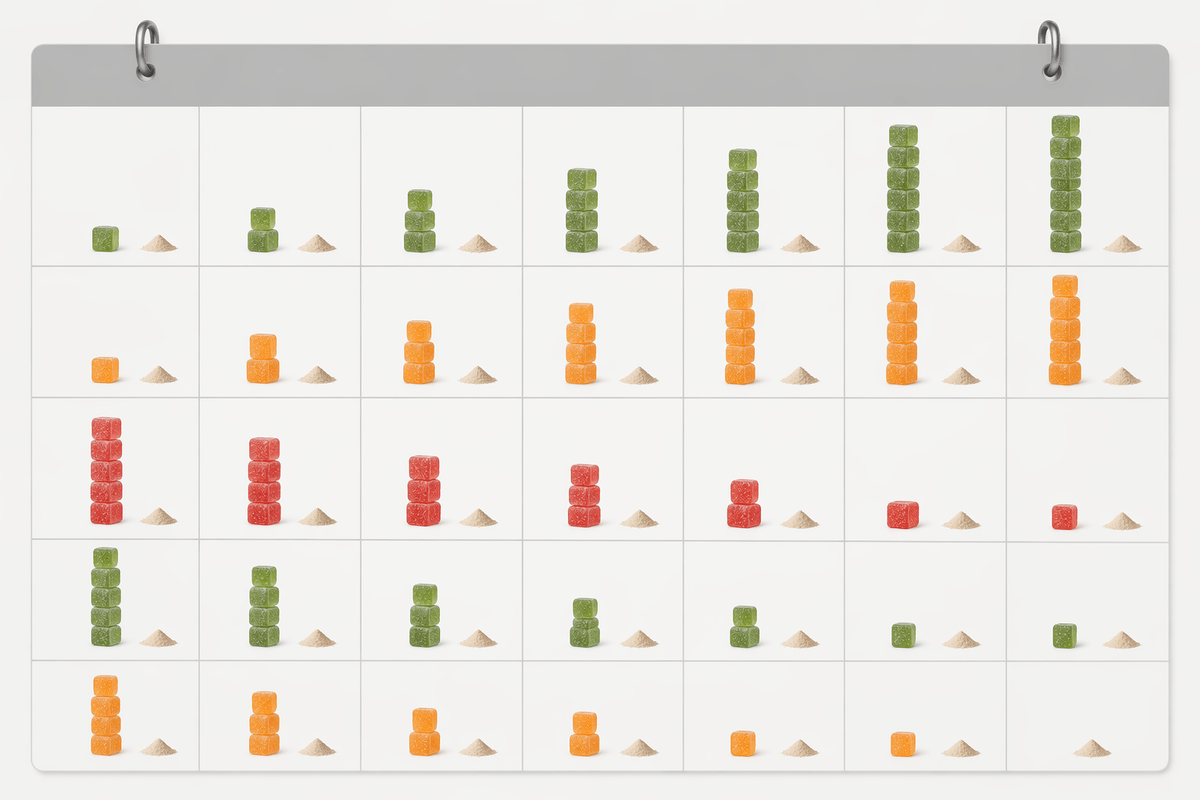
It often shows up in a tiny moment: you’re holding the bottle and realize the “one serving” isn’t one piece. With gummies, the label might say 4–6 gummies for a full dose, and each gummy can be a fraction of a gram. If you’re not counting, your daily total can drift without you noticing—especially when “close enough” feels reasonable on busy mornings.
Powder looks more straightforward, but the math can get slippery there too. One scoop isn’t always one exact weight, and a heaping scoop can turn “about 5 grams” into something meaningfully higher. Even the way powder settles (or clumps in humidity) can change what fits in a scoop, so volume-based measuring can be quietly inconsistent.
The practical difference is that gummies hide the arithmetic in pieces, while powder hides it in measuring habits. Over weeks, those small mismatches can add up in either direction.
Stomach comfort, sweetness, and unexpected side effects
Sometimes the first “signal” isn’t in the gym at all—it’s later in the day, when your stomach feels a little off and you can’t tell if it was lunch, stress, or the new supplement you started. With powder, people often notice a heavy, gritty feeling when it’s dumped into too little water or swallowed fast. Creatine itself can pull water with it, and if it sits concentrated in the gut, that can feel like bloating or urgency for some people.
Gummies can create a different kind of surprise: sweetness that doesn’t feel like “a supplement” anymore. A serving that’s 4–6 pieces may bring sugar alcohols, acids, or extra flavoring along for the ride, and that combination can be the real driver of gas or stomach noise—even when the creatine dose is modest.
Neither pattern is guaranteed or dangerous on its own, but the practical limitation is that discomfort makes people start skipping days. When that happens, it can look like creatine “doesn’t agree with you,” when it may be the concentration, the add-ins, or simply how the serving fits into the rest of your day.
Convenience and adherence in real daily routines
It usually becomes obvious on the first rushed morning: the powder is still on the counter, and you’re already in the car. Mixing isn’t hard, but it asks for a cup, water, and a moment where you’re not juggling keys and emails. If your creatine habit is tied to a shaker you only use on training days, “daily” can quietly turn into “most workout days,” which may feel consistent until you look at the calendar.
They’re easy to keep in a bag, take between meetings, or remember after dinner. The convenience can blur the boundary between a dose and a snack—especially when the serving is multiple pieces and you’re not sure if you already took them. Over weeks, adherence isn’t just whether you took creatine; it’s whether you reliably took the full amount often enough that the routine actually behaves like a routine.
Ingredients beyond creatine: sugars, acids, and additives

You notice it when you toss the tub or bottle into your cart and the “other ingredients” list is longer than you expected. With powder, that list is often short—sometimes it’s basically creatine and maybe a flavoring or sweetener if it’s not plain. With gummies, the chew has to come from somewhere: gelatin or pectin, sweeteners, coatings, colors, and acids to keep the flavor sharp.
That matters less for one day and more for the way it nudges your routine. A multi-gummy serving can quietly add calories or sugar alcohols, and those sugar alcohols are a common reason people feel gassy or urgently “off” even when the creatine dose isn’t high. The acids and flavor systems that make gummies taste bright can also feel harsh if you take them on an empty stomach, which can turn “easy” into “I’ll skip it today.”
A plain powder may be simpler on paper, but if you only tolerate it in a big drink you don’t always finish, the ingredient list stops being the main issue.
Cost, storage, and choosing based on your constraints
You usually feel the cost difference in a boring place: when it’s time to reorder and you realize the tub is still half full, but the gummy bottle is already empty. With gummies, the creatine is only part of what you’re buying—texture, flavor, packaging, and the fact that a “dose” might be several pieces. That can make the daily price feel small until you do the serving math over a month.
Storage can quietly change the experience, too. Powder is mostly a pantry item, but it can clump in humidity or turn messy if the scoop disappears. Gummies are portable, but heat can soften them into a sticky mass, and “leave it in the car” becomes a real limitation. If your days are mobile and you’ll actually take gummies, the higher cost may be worth it. If budget pressure is what makes you start skipping, a plain powder you’ll measure consistently often ends up being the simpler constraint to live with.